Sep 27, 2017 | Article
With a dynamic curriculum and growing public-private partnerships, the Portsmouth Career Technical Center is preparing its 280-plus student population for the challenges of a 21st century economy.
“Our goal has always been to give our students the experience and certifications they need in industries that will allow them to stay right here and home and make a really good living,” said Diane Canada, Career Technical Education Director. “When you look at which jobs are available, and which industries really need skilled workers, we’ve found a nice balance here in Portsmouth.”
Changing the dynamic
Launched in 1977, Portsmouth Career Technical Center’ s focus was largely vocational in focus and scope. Serving first as a culinary arts instructor, Canada saw the center grow to include courses in electronics, automotive, TV production, and even architecture.
While language at the federal level began to shift—from “vocational” to “career-technical”—Canada and her peers recognized even then where the real change was taking place.
“It was about letting people see and know that while we were still offering some traditional trades and programs, we were also getting into the new and developing industries in our state,” she said. “This remains a big motivator for us, which is to provide a workforce for our state while giving students the skills they need to prosper.”
When she took over as director 10 years ago, Portsmouth’s Career and Technical Education (CTE) was in a state of transition, as the school opted to add more business courses. Canada believes the move was instrumental in helping recalibrate the school’s CTE strategy.
“As in many high schools, a lot of our students have goals of majoring in business in college,” she explained. “This was an initiative that my former director had started and I felt it was important to continue it.”
With two full-time business teachers, Portsmouth High has launched a number of promising initiatives in recent years, including a two-year, state-sanctioned entrepreneurship program. Two classes, Accounting and Intro to Business, are offered as Running Start courses in conjunction with Great Bay Community College.
Though demand in construction has never been higher, Canada and her colleagues have completely reimagined their school’s approach to the trade, combining courses in architecture and construction to create a new program called Design-Build. According to her, the plan is for students to work side by side with industry experts on projects in and around the city.
“Our long-term vision is to have full-scale projects where students are designing and building as part of the class,” she said. “We’ll also have tradesmen from the community come in—plumbers, HVAC professionals, electricians, architects—and expose students to all aspects of that industry.”
With support from the New Hampshire Charitable Foundation, the center launched a dedicated computer science program, which garnered assistance from Great Bay’s IT Department Chair, Meg Prescott, who provided the program with “a running start” by teaching GBCC courses at the high school for two years to build interest. This year, the CTC has a hired yet another computer science teacher who will continue to build the program.
CTE today at Portsmouth High School
Today, CTE curricula at the school brims with career-track potential: four computer science classes eligible for college credit; 13 credits offered through PHS’s teacher-training program; six business credits; and articulation opportunities at myriad schools throughout New Hampshire and Southern Maine.
“Portsmouth is a community where 80 percent of students go on to post-secondary institutions, so we’ve really needed to create niche programs that were unlike anything else in the state,” Canada said. “I think we’ve done that.”
For Canada, the goal of CTE is to stay ahead of the curve.
“The most exciting thing for us is when our students come back after their first year in college, or even during their first year, and tell us how prepared they were,” she said. “We’re proud of what we’ve been able to accomplish, but it’s also important to remind parents and students that these programs are available statewide and they’re getting better all the time.”
Sep 8, 2017 | Professional Development, Tid Bits
The Career Development Bureau is co-sponsoring a Fall Professional Development Day on Friday, October 6, 2017, at the Concord Regional Technology Center (CRTC). During this day we are offering several opportunities for CTE teachers to work together in cluster-based teams and to spend time talking and sharing resources with other CTE teachers from similar programs across the state. Register at: https://goo.gl/forms/sjSgUMUbr7BAamaG3

Aug 31, 2017 | Article
With employers across a variety of industries in the Granite State struggling to meet their hiring needs, Career and Technical Education (CTE) centers have become an increasingly important resource.
The capacity of CTE centers to develop the skilled workforce of tomorrow, however, has been significantly enhanced in the past two years through an innovative collaboration with the Sector Partnerships Initiative (SPI). An industry-driven statewide initiative to help businesses in targeted industries address workforce needs while helping workers prepare for—and advance in—their careers, SPI is initially focused on four industries: manufacturing, hospitality, healthcare, and information technology.
According to Phil Przybyszewski, Workforce Solutions Project Director, NH Sector Partnerships Initiative, each of the selected industry sectors are defined by several distinct characteristics and challenges:
Manufacturing
• 67,800 employees across 1,950 businesses (average = 35 employees)
• Relatively flat projected growth
• High churn rate caused by retirements; 30+% over age 55
• Strong hourly wage
• Top needs: CNC machinists, Machinery Mechanics, First Line Supervisors
Health Care
• 88,000 employees spread over 2,800 establishments (average = 31 employees)
• Growth projections 10% to 15% over the next five years
• Good wage rates at the top but quickly drop
• Top needs: Registered Nurses, LNA, MA
Technology
• 61,000 employees
• Grow rates approaching 12% over the next five years
• High hourly wage in the range of $37.00
• Top needs: Developers, Systems Analysts, User-Support Specialists
Hospitality
• 68,000 employees spread across 4,500 establishments (average = 15 employees)
• 70% of jobs are concentrated in food services and drinking establishments
• Younger workforce with 36% below age 25
• High turnover caused by lower wages and seasonal nature of employment
• Top needs: Better defined career pathways and training
“The SPI model is effective because it is problem rather than program oriented,” said Przybyszewski. “We are working with numerous partners to address real industry needs—no one needs to be working independently on their challenges.”
Nashua Technology Center
One of the ways in which SPI works is through dynamic collaborations either with industry leaders and/or CTE centers with scalable capacities. Led by Co-Director Marianne Dustin, Nashua Technology Center (NTC) represented a unique opportunity for SPI, which has helped to “rejuvenate” its Manufacturing program.
“It was hurting,” said Przybyszewski. “Enrollment was down, but there was enthusiasm around what was possible. There was potential.”
Noting SPI can assist CTE programs in several ways—funding or an infusion of new advisory board members, which took place in the NTC’s case represent two examples—he said its purpose is to better leverage existing capacities.
“This is a great example of tapping into SPI assets to make a difference,” he added. “Nashua had a great lab and great equipment—we adopted them as one of our initiatives within our manufacturing initiative.”
As for how SPI impacted NTC, Dustin noted their involvement helped create a meaningful pathway from Algebra into a career in Manufacturing.
“We are introducing AMPED, an Algebra curriculum that enables students to learn core concepts in Algebra through the lens of manufacturing processes, entrepreneurship and design,” she said.
In order to access the year-long curriculum, NTC sent an algebra instructor to a week-long conference in Colorado for training in implementation at the school. With the program launching this fall at full capacity with 36 students, Dustin said their relationship with SPI has helped them place an assortment of manufacturing and machining professionals as instructors.
“It’s a creative partnership that brings these professionals directly into the classroom,” she said. “Some programs have an Algebra and a Manufacturing instructor, but we can make this happen right now with just one instructor, which gives us some flexibility from a financial perspective. It is also a more effective way to teach students.”
As an example of the curriculum, she said it goes beyond the “Xs and Ys” generally associated with Algebra.
“Students will be presented with real-world problems where they will have the opportunity for hands-on learning,” she said. “Through the process of solving problems with real applications, the students will then back into the conceptual part of Algebra…Manufacturers are not working with X and Y. This program is a much more effective way to teach students skills and concepts at the same time.”
Looking ahead for SPI
According to Michael Power of the Office of Workforce Opportunity, NH Department of Business & Economic Affairs, SPI represents “a new way of doing business with the state’s employers.”
“Working with New Hampshire’s diverse industries by economic sectors is a more efficient and effective way of meeting the challenge of creating pipelines of employment opportunities for current and future workforce needs,” he said. “By involving employers in areas such as curriculum, career pathways and appropriate training, we can sustain and grow our workforce, our companies and our economy.”
Citing the partnership with NTC as one of several related projects supported by SPI, Przybyszewski said they are also beginning to look at a 5th sector in industry.
“We are in the exploratory stage of looking at Infrastructure,” he said. “This includes Construction, Broadband and Energy. We are completing our mapping of the assets associated with these sub sectors and will move to workforce planning next to identify key stakeholders to drive the initiative.”
To learn more about SPI, visit www.nhworks.org/Sector-Partnership-Initiative/Overview.
Aug 19, 2017 | Professional Development, Tid Bits
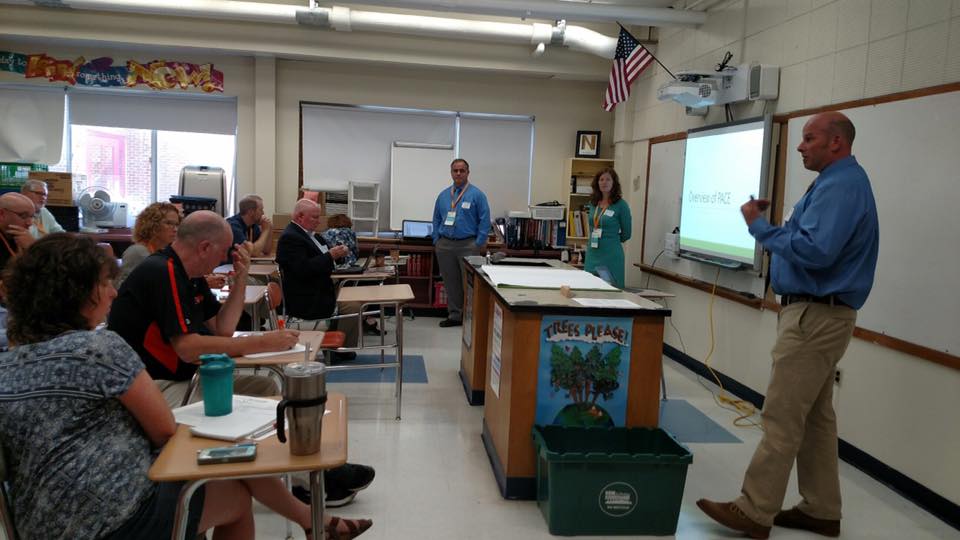
Close to 150 teachers, administrators and other professionals gathered at Rundlett Middle School in Concord for the first ever NH CTE Conference. Over the course of two days, participants attended workshops featuring topics such as PACE, postsecondary pathways, Depth of Knowledge and OSHA requirements. Justin Wells of Envision Learning Partners, Frank Edleblut, the NH Commissioner of Education, Paul Leather, the NH Deputy Commissioner of Education, Eric Feldborg, the State Director of Career & Technical Education, Steve Rothenberg, President of NH Career & Technical Administrators, and others took part in the keynote addresses. Everyone who attended is already looking forward to next year!

Aug 14, 2017 | Article
Earlier this year, the 27 Directors and Administrators of NH’s Career and Technical Centers (NHCTA) created a new position—executive director—for the NH Career and Technical Educators association (NHCTE).
Lasting several months, the search resulted in the hire of Christine Carr, a NH native who has helped more than 500 small technology businesses launch and grow through her work at the Canadian Consulate in Boston. She is also the Co-Founder of the Canadian Technology Accelerator in Boston, an incubator program that helps Canadian startups launch in the United States
“I am very passionate about growing new organizations and launching businesses,” she said. “I think a big reason behind my enthusiasm for this line of work was watching my parents establish and build a successful NH-based manufacturing business.”
Describing both her father and brother as “gifted machinists,” she said her deep respect and passion for technical expertise and craftsmanship is in her DNA.
“I think my background—both professionally and personally—helps provide me with some important initial insight into the task at hand. In regards to her role, she said her first order of business is to help launch, establish and grow NHCTE.
“NHCTE is a large career and technical community that consists of more than 10,000 students, parents and families as well as hundreds of teachers, employers and other supporters,” she said. “The potential behind this community is extensive.”
Mapping it out
In mapping out the CTE landscape around the state, Carr laid out a 4-step action plan. She said her first move is to meet with the directors at each of the state’s 27 CTE centers within the next 90 days.
“I want to meet with the directors in their own environments and learn about their networks, existing partnerships and their unique cultures,” she said.
She said her objective in meeting with individual directors is to get a sense not just for the commonalities that bind each center together, but what differentiates one from the other.
“I want to get past the quantifiable data—‘x’ number of students or programs—and get to the qualifying factors, the things that will capture the imaginations of those inside and outside the CTE community,” she said.
According to Carr, step two and three of her plan consists of highlighting what is unique about CTE and then demonstrating what has already been accomplished.
“CTE has been delivering for decades – it is proven and validated, happening right now,” she said. “People need to understand that and feel proud and excited about it…All stakeholders need to be engaged.””
Carr said her fourth step will build on—and take place at the same time as—the previous three steps.
“I call it ‘market momentum,’ which means we have the chance to capture this opportunity at this point in time right here in this moment,” she said. “Everything is aligned right now and that is a very rare occurrence for any organization—it is what attracted me to this position. My role is to catalyze each area of potential growth and encourage the community to take over. I believe this can happen here in NH with CTE.”
To contact Carr, email ccarr@nhcta.org.