Oct 28, 2016 | Tid Bits
Last month, 30 NH school counselors got together at Manchester Community College and had a terrific interactive experience learning firsthand about 21st century careers and career readiness. The reviews of this event were hugely positive (see attached on page 3-4). Round #2 is on Election Day, November 8th in Lebanon, NH. We will be touring and meeting leaders of Hypertherm Corp. and Dartmouth-Hitchcock Hospital.
- 8:20 am Arrive Lebanon at Hypertherm
- 8:40 am Tour of HyperthermCorporation (cutting edge high tech advanced manufacturer of plasma cutters) Lebanon, NH
- 11:40 Lunch
- 12:30 pm Meeting and information sessions with Sarah Currier (Director, Workforce Development) of Dartmouth Hitchcock on their apprenticeship program where employee are demonstrating performance measures associated with competencies (assessed by doctors).
- 1:30 pm Debrief and Process
- 2:20 pm Leave Lebanon (OK leave earlier if needed)
Last month Mark Holden (ABC), Pete McNamara (NHADA), Mike Somers (NHLRA), Emily Gagnon (ex of Albany / Saffron), Chancellor Ross Gittell (CCSNH), and President Susan Huard (MCC) really set a high bar. The dialog was tremendous — and energetically went both ways. We want to keep the momentum.
To register contact School Counselor Leader Rebecca Schaefer rschaefer@sau8.org . Also the next two events are: 1/17 and 3/10 details TBD.

Oct 9, 2016 | Building & Construction Trades, Tid Bits
Check out the television covereage of this super successful event!
https://www.wmur.com/new-hampshire-chronicle/tuesday-october-4th-new-hampshire-construction-career-days/41883486
Sep 18, 2016 | Article
In early August, approximately 25 New Hampshire CTE instructors attended a two-day, project based learning (PBL) workshop in Concord with Marty Sugerik of the Southern Regional Education Board There were about 25 attendees that participated. In total, the training provided 13 hours of Professional Development over a two day period.
Areas covered during the two days ranged from how to implement icebreakers and class warm-ups to class notebooks and incentive programs. Teachers also learned about station teaching, which promotes collaborative independent learning by grouping 3-4 students together where they are assigned a task.
In station teaching, students are not allowed to ask the teacher questions, yet are allowed to use any resources they can find to solve the problem. Each student is responsible for demonstrating and documenting his or her work. Each group is responsible for documenting multiple solutions if consensus is not reached, while individual students are responsible for communicating on behalf of the group.
“In Gold Standard PBL projects, Marty also spent a considerable amount of time showing us his food truck project and how it relates to real world situations, which often tap into CTE topics,” noted attendee Heidi Havron, who teaches Math at the Manchester School of Technology. “It was stressed that there needs to be a real world component/CTE component to legitimize the portions of the project that relate to a particular field.”
The Career Development Bureau sponsored the professional development opportunity.
“We have received a great deal of positive feedback on the workshop and look forward to seeing the results of the project-based units that are rolled out over the coming year,” said Courtney Ritchings, NHDOE Career Development Bureau.
According to Havron, the entire training was quite productive. She said it was particularly beneficial that Sugerik was a math teacher and added math content to his program.
“At the end of the training, I had new techniques and examples of how to engage students with math problems, activities and projects that promote collaborative, yet accountable learning,” she said. “In addition, I was exposed to a slew of resources that can help me create my own material to use with the students.”
Sep 18, 2016 | Article
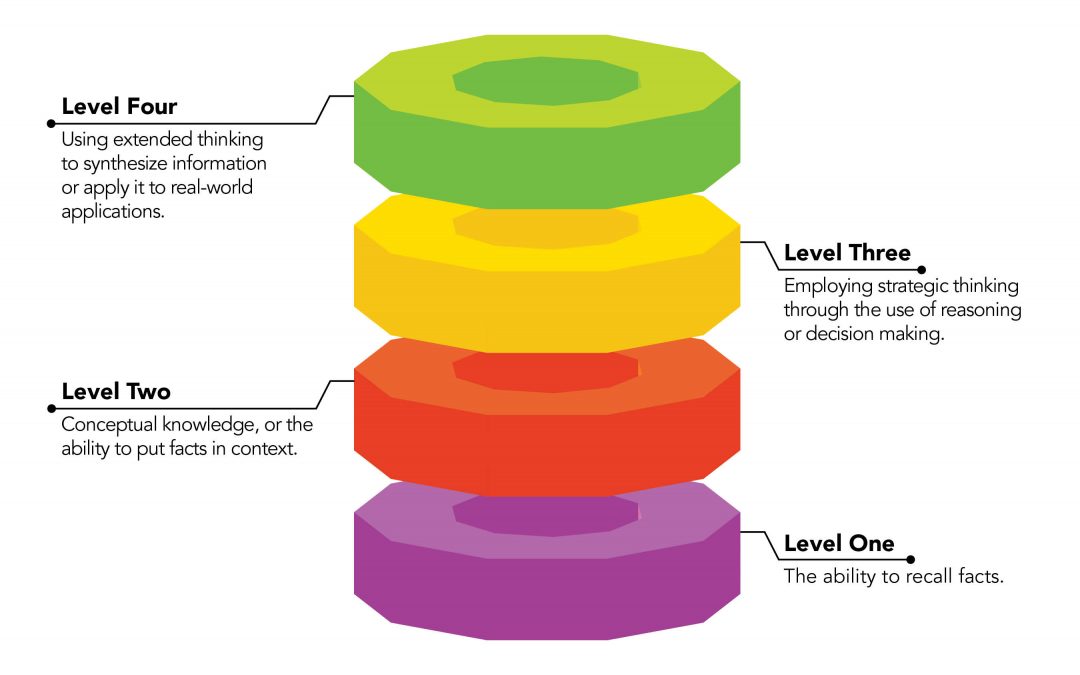
It is not so much what student knows, but how and what he/she does with that knowledge that will serve the needs of industry today and tomorrow, which underscores the usefulness of the Cognitive Rigor Matrix. Designed by Karen Hess, the Matrix is a tool and resource that Career and Technical Education (CTE) teachers can use to help guide and scaffold lessons. As opposed to grading or measuring a student’s demonstration of a competency, the Matrix reveals the complexity of a task or activity at the point of instruction.
Kirsten Soroko, who trained CTE teachers statewide in how to use the Matrix this summer, said its widespread use in the secondary school setting has far-reaching implications. “A student’s depth of knowledge is based upon rigor of the mind, which is complexity over difficulty,” she said. “Teachers who use the Matrix as a way to build complexity enable students to build process and inquiry rather than simply promote rote memorization.”
According to Doug Cullen, founding president of the Vermont/New Hampshire Career Development Association (VT/NH CDA), promoting ‘rigor of the mind’ represents a shift toward the utilization of work-based learning (WBL) initiatives in the career development process.
“There are a variety of interventions in place surrounding career development as a discipline and the use of experiential learning as a strand within,” he said. “This approach is driving improvements in student efficacy, engagement, overall learning and a host of other benefits…The key is to create partnerships between secondary, post-secondary and industry-involved education providers.”
Beth Doiron, director of College Access and DoE Programs at the Community College System of NH, agreed and said the business sector is also critical. She cited one recent example in Manchester in which several area companies approached Manchester Community College regarding a need for tube welders.
“We are working with them to fill that long-term need,” she said. “Everything taking place within the CTE sector is aligned with real needs in the labor market.”
Lisa Danley, director of the Cheshire Career Center in Keene, added that CTE is defined by its usefulness across multiple spectrums.
“The programs we offer are aligned with college courses and programs and industry needs across the state,” she said. “Programs are not designed in a vacuum.”
In helping teachers instruct students on how to think rigorously, Soroko said CTE is preparing the next generation of problem solvers. “It is time for us to start teaching our kids how to think,” she said. “It is not about memorizing content, but how we use content and transfer it to something new to solve problems…this is the new CTE.”
According to Jen Haskins, director of Career and Technical Education at Pinkerton Academy this new way of conceptualizing and implementing CTE across the state results in immediate benefits for students, too.
“All of our programs are aligned with high skill, high wage jobs—we are not putting out students that just have entry level positions,” she said. “Obviously, they still need to work and progress in their industry and through other continuing educational opportunities, but they can hit the ground running and make livable wages while they advance.”
Noting advancements continue to be made in the general community’s perception of CTE, Steve Rothenberg, board president of the New Hampshire Career and Technical Administrators (NHCTA), acknowledged one of their biggest challenges remains one of leverage.
“We need to create a model where the state can leverage best practices, so teachers’ strengths are maximized and the interests of students are best served,” he said. “Promoting cognitive rigor is one of the tools we will continue to deploy to best ensure these internal and external needs are met.”
Sep 17, 2016 | Article
Every so often great minds come together to create a source of synergy the whole of which exceeds the sum of the parts. Thus, is the case with two giants of career development in the United States.
The National Career Development Association (NCDA) has worked with the Association of Career and Technology Education (ACTE) to enhance “membership collaboration” between the two organizations beginning this Fall 2016. This collaboration recognizes and honors the common ground of guidance and career development between the two national organizations. The initiative, which is currently being referred to as an “Professional Development Package” (PDP) is designed to encourage shared professional development, career development resources, best practices, legislative advocacy, and professional networking between the two national leaders in guidance and career development.
The PDP package is set to be announced as $70 for new members of either organization. This fee will be collected by each organization with membership information collected in a common database. Existing members of either organization can opt to receive this PDP of a nominal fee of $35.
NCDA will be adding anyone new to this PDP opportunity as a “New Professional Member” beginning immediately and ensuring that these professionals will get full membership benefits in NCDA. In a similar manner, ACTE is developing their membership option to provide access to extensive guidance and career development electronic communications, resources, and professional development. For those existing NCDA members who take advantage of this option, they will receive a benefits package from ACTE that targets both K-12 and higher education professionals.
Soon, both organizations will be marketing this option to their members. NCDA plans to use the following to enlighten its members of this inter-organization collaboration:
1. Announcement via e-bulletin (covers full membership)
2. Web listing under Latest News
3. Career Convergence Article with link to options available to all NCDA members
4. An article to ACA’s Counseling Today about effective collaborations for those NCDA members whose NCDA membership is shared through their ACA membership
5. Additional press releases to other sister organizations (like NAWDP, NACE, ASCA, smaller sister organizations, etc.) showcasing this collaborative agreement
Estimated start date is September 1st pending changes needed for membership issues at both organizations.
ACTE’s Jan Bennet-Bell, Vice-President of the Guidance and Career Development Division, is handling the marketing for ACTE members and will serve as liaison to NCDA through her three-year tenure as ACTE Board member. Ray Davis, NCDA Board Trustee for School Career Counselors and Specialists, will be working with NCDA Executive Director, Deneen Pennington, to market the above membership roll out to NCDA members.
This collaboration is rooted in three years of professional exchanges. Both Jan and Ray have attended the last annual conference of each of the two organizations to set the groundwork for this PDP. NCDA Past-Presidents Rich Feller and Lisa Severy, and current NCDA President, Cynthia Marco-Scanlon, have attended ACTE’s annual conference each of the past three years.
Both organizations are excited about the collaboration developed during the 2015-16 year. ACTE has extended the hand of collaboration on legislative policy and advocacy with NCDA’s Government Relations Committee, as well as our NCDA staff at LobbyIt in Washington, DC. This unified effort has been very effective as the two organizations unilaterally advocated for stronger legislation for career guidance in WIOA, ESSA, and Perkins reauthorization. ACTE’s National Policy Seminar has been discussed as a rallying point in Washington in early March 2017 for joint organizational legislative advocacy.
NCDA has reached out to New England CDA and CTE professionals to include them in our Career Practitioner Institute in Groton, CT, in October. For more information, see https://ncda.org/aws/NCDA/pt/sp/cpinstitute.
What does the future bring for this collaboration? The sky is the limit! The PDP leadership is investigating collaborative webinars on topics of expressed need by members of NCDA and ACTE. Each organization will continue to offer the other organization featured workshop slots at their annual conference. Identified professional development such as post-secondary career pathways and transitions, career decision making, the usage of career assessments and technology, and career guidance skill-development are but a small number of topics that the two giants of guidance and career development are mulling as part of the “common ground” of the collaborative.
by
Guest contributor Ray Davis, Ph.D.
NCDA Trustee
School Career Counselors and Specialists